
Hippie Trail Route: Istanbul to Kathmandu, Then and Now
Where did the Hippie Trail go? Explore its historic route, Kathmandu and Goa branches, and what the old map means for travel today.

Hike List
Posted on 12 Oct, 2026
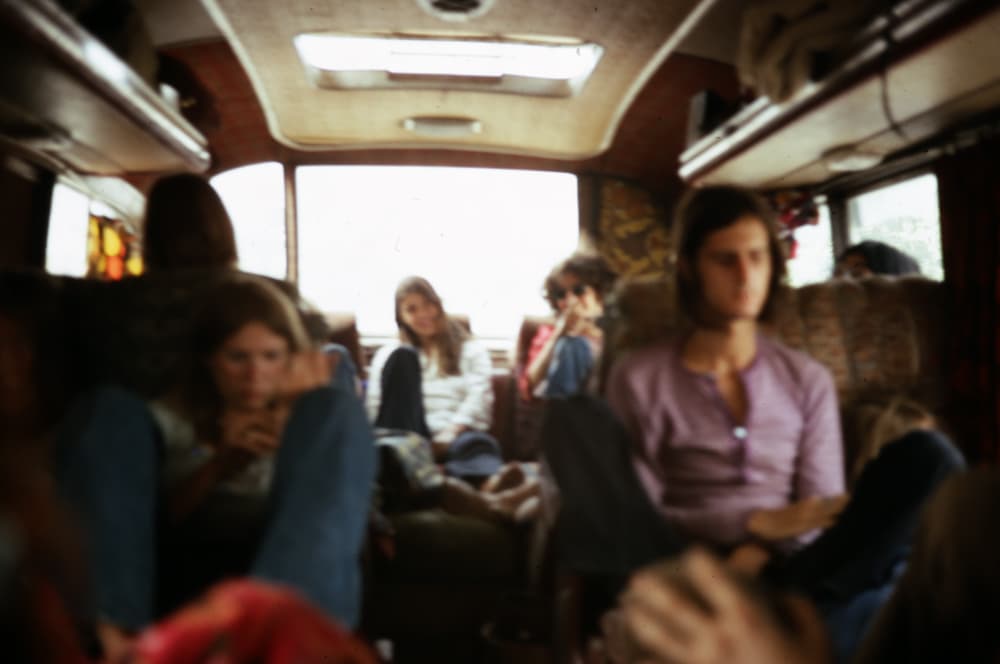
Archival photograph: travellers on a bus in northern India, 15 March 1973, as described by the photographer. Richard Weil / Wikimedia Commons, CC0 1.0. Displayed to fit; not a photograph of present-day conditions.

The Hippie Trail was an overland travel network between Europe and South Asia, especially associated with the 1960s and 1970s. A familiar route ran through Istanbul, Iran, Afghanistan and Pakistan into India, with travellers continuing to Kathmandu or heading elsewhere, including Goa. It was not a marked hiking trail, and there was no single official itinerary to complete.
The name can make it sound like a line waiting to be followed. The surviving accounts tell a more interesting story: journeys assembled from public buses, trains, shared rides and places where someone might know how to get farther east. Hans Roodenburg's photographs and account of his 1967–68 journey are one unusually tangible record.
Where did the Hippie Trail go?
Think of Istanbul as a meeting point, not a compulsory starting line. Roodenburg describes approaches through Europe, including the former Yugoslavia and Greece or Bulgaria, before Turkey. People arrived from different countries and travelled in both directions. The familiar eastbound sequence is useful for understanding the geography, not for assigning everyone the same trip.
The table below follows the broad sequence in Roodenburg's documented journey. These are historical places and connections, not present-day travel instructions.
| Part of the journey | Places in the account | What the source establishes |
|---|---|---|
| Turkey | Istanbul; onward across Turkey | A meeting point on the overland journey from Europe, rather than its only possible beginning. |
| Iran | Tabriz → Tehran → Mashhad | Roodenburg describes a mixture of minibus, train and bus travel, not one through-service. |
| Afghanistan | Herat → Kandahar → Kabul | His main journey crossed the country; the archive also includes side trips that should not be mistaken for the main road. |
| Pakistan | Khyber Pass → Peshawar → Lahore | A historical approach to India. The account is not evidence that these crossings or roads are suitable now. |
| India | Delhi; Benares, now usually called Varanasi; Raxaul | Places in his onward journey toward Nepal, not a compulsory checklist for every overlander. |
| Nepal | Kathmandu | The destination he reached a few months after leaving in autumn 1967. |
Read the original country accounts for Iran, Afghanistan, Pakistan, India and Nepal. A named, dated journey is more useful evidence than an unsourced list presented as the definitive route.
How to read a Hippie Trail map
For a visual overview, open NordNordWest's schematic Hippie Trail map. It is a modern illustration of historical routes, first created in 2013, not a map carried by travellers in the 1970s or a current navigation map. Use it to understand the broad geography, then consult the dated travel accounts for individual journeys.

Do not turn its lines into a GPX track. They do not establish which road, border crossing, ferry or bus is usable today. Nor is a map's apparent continuity proof that a journey can currently be booked from end to end.
Did the trail end in Kathmandu or Goa?
Both belong in its history; neither was everyone's finish. Kathmandu lies in Nepal. Goa is on India's west coast, so a Goa journey is not simply the next stage of a straight line to Kathmandu. Putting both names on a map should not turn them into mandatory consecutive stops.
There is concrete evidence for both associations. Roodenburg reached Kathmandu, and Rick Steves preserves a separate 1978 journey in his original journal and photographs. In Goa, the state tourism development corporation describes Anjuna's hippie-era association. Those are different sources about different experiences, not evidence of one universal itinerary.
This is also why an exact answer to “How long was the Hippie Trail?” needs qualification. Which starting city, destination and side trips are being counted? A London-to-Kathmandu estimate cannot stand in for Istanbul-to-Goa. This guide deliberately gives no official total distance, stage count or completion time.
Two places that make the history tangible
Istanbul: the Pudding Shop's message board
According to the restaurant's own history, Idris and Namik Çolpan opened Lale Pastanesi in 1957. Travellers came to know it as the Pudding Shop. Its bulletin board brought together people offering rides and people looking for them, while travellers found companions with whom to share costs.
That detail explains the route better than another photograph of a painted van. Part of the infrastructure was social: a restaurant, information and a possible lift. The people running such places were participants in the story, not scenery around it.
Kathmandu: Freak Street, not simply Thamel
The historical name to look for is Jhochhen, also written Jhonchhe, associated with “Freak Street.” Do not assume that any reference to Kathmandu's backpacker history means Thamel. Nepali Times describes how Thamel developed as a backpacker destination in the 1970s, replacing Jhonchhe's earlier prominence.
Approach these places as neighbourhoods with their own histories, not preserved sets from someone else's youth. Comparing a dated photograph with the same place today can be more revealing than trying to recreate a stranger's adventure.
Was everyone on it a hippie?
No. In the introduction to The Hippie Trail: A History, historians Sharif Gemie and Brian Ireland explain that most people in their sample of 80 journeys would have rejected that label. Their study covers 1957–1978. The familiar name is convenient, but it should not flatten every traveller into the same politics, beliefs or reasons for leaving home.
Can you still do the Hippie Trail today?
Not as a ready-to-follow itinerary through the historic corridor. The upheavals of 1979, including the Iranian Revolution and Soviet invasion of Afghanistan, were major breaks in the route's history. In his PBS interview about travelling in 1978, Rick Steves reflects on that change. This is different from claiming that every road permanently closed on one date.
Travel-advice check: 12 October 2026. The UK's Foreign, Commonwealth & Development Office advised against all travel to Iran and Afghanistan. Its Pakistan advice also covered parts of the historic corridor, including Peshawar and Khyber, with an against-all-travel warning; all of Balochistan was under that warning too.
The same Pakistan page listed the Wagah border crossing as closed, while noting that visitors could still attend the border ceremony. Seeing a ceremony is not the same as being permitted to cross. Recheck that page rather than relying on this dated snapshot.
These are British government advisories; use your own government's advice and the relevant entry authorities for your nationality. An old memoir, a tour advertised online or a recent traveller's successful crossing does not establish safety, visa eligibility, insurance cover or an available onward connection for you.
A better way to plan a trip inspired by it
Start with the part that interests you: Istanbul's overland-travel history, Kathmandu's neighbourhoods or Goa's coast. Research it as a separate destination, with current entry requirements, local conditions and a return plan. Do not make a chain of high-risk borders the price of experiencing the history.
For a walking journey, choose an actual walking route rather than treating the word “trail” literally. Wyld Quest's Annapurna Circuit overview is a separate Nepal trekking project, not a walkable continuation of the Hippie Trail. Our Balkan hiking guide offers a different way to explore part of Europe on foot. Both need their own current planning and access checks.
The worthwhile inheritance is curiosity, time and attention to the places between famous destinations. You do not have to reproduce the old route to travel with those qualities.
Historical sources and travel advisories reviewed 12 October 2026. This article explains a historical route; it is not a live border, road or trail advisory.