
Catskill 3500 Club: 33 Peaks, Four Winter Repeats and How to Plan
Plan the Catskill 3500 Club's 33 peaks and four winter repeats, understand changed access rules, and keep an accurate summit log.

Planning the Catskill 3500 can be confusing before your first climb. You'll find references to 35 peaks, 33 summits, 37 ascents and a separate winter list. They aren't interchangeable, and one of those older summit lists points to mountains closed to the public. Here is how to plan the current challenge without a misleading checklist or an invented route.
The short answer
The Catskill 3500 Club asks for 33 designated peaks plus four additional winter ascents for regular membership. Those winter repeats are Slide, Blackhead, Balsam and Panther. The tally is therefore 37 ascents, not 37 different peaks. The Club's winter membership and patch is a distinct goal: all 33 peaks must be climbed in winter, and the four required repeat ascents still apply. Before building your checklist, use the official membership tally sheet rather than an older 35-peak graphic.
Why some guides say 35 peaks
Doubletop and Graham were closed to the public in January 2021. The Club subsequently removed those two peaks from the membership requirements, along with the temporary substitutions South Doubletop and Millbrook Ridge, effective March 22, 2021. A list that still directs you to hike Doubletop or Graham as mandatory public objectives is out of date. The current count and history are explained on the Club's peaks page. Closed private-land summits are not a challenge to navigate around: respect the closure.
Four winter repeats: do you need a separate winter round?
For the standard membership, complete the 33 designated summits in any season, then hike Slide, Blackhead, Balsam and Panther an additional time in winter. The Club defines winter as December 21 through March 21 inclusive, regardless of astronomical solstice or equinox dates. A winter patch requires all 33 designated peaks during that calendar window, with the four repeat-peak rule accounted for. If you're pursuing both types of recognition, log each ascent by date and season instead of assuming the regular checklist automatically becomes a winter round. The patch requirements are the authority.
Trailed peaks and the untrailed challenge
This project is not simply 33 waymarked trail walks. The Club identifies 14 summit canisters where hikers should make an effort to sign the notebook: Southwest Hunter, Lone, Big Indian, Friday, Rusk, Kaaterskill High Peak, Fir, Balsam Cap, North Dome, Eagle, Sherrill, Vly, Halcott and Rocky. Some objectives require off-trail navigation. Study the Club's untrailed-peaks information, use an up-to-date topographic map and compass, and have a reliable exit plan. A summit list is not a GPX route, and a line drawn directly between peaks can be unsuitable, inaccessible or dangerous.
How to plan a first Catskill 3500 season
Start with a trailed objective and an itinerary you can comfortably complete in daylight. Use an official map to identify a legal trailhead and specific approach; check conditions and land access before departing. Then group later outings by realistic trailheads and terrain, not simply by summits that look close together on a screen. For the more remote and untrailed peaks, build navigation competence on easier ground first or consider the Club's guided hikes. The Club does not give blanket permission to reproduce its full group-hike schedule; use its live schedule directly.
Make a log that will still work when you apply
For each ascent, record the summit, date, route or start/end trailhead, weather, trail conditions and companions, alongside notes useful to your future self. Mark winter repeats separately from first ascents. The Club's membership instructions ask for substantial notes, which become part of its records and inform the welcome letter. Keep the official tally sheet as the membership authority and use any digital progress tracker as a companion, not a replacement. This avoids the common trap of finishing the hikes but reconstructing the dates afterward.
Camping, access and conditions
Check New York DEC's Catskill Backcountry Information for active notices, rules and planning guidance. On Forest Preserve land, dispersed camping is generally restricted above 3,500 feet outside winter and must meet setbacks from water, roads and trails; longer trips and certain group sizes require permits. Campfires are prohibited above 3,500 feet. These camping rules do not imply any particular summit route is open or that you have permission to cross private land. Avoid cutting or flagging off-trail paths, and check current trailhead and seasonal conditions rather than relying on an article's publication date.
Which challenge should you do next?
If you enjoy a long-running mountain project, the Catskill 3500 is appealing because it asks you to return across seasons and develop route-finding judgment. If you want a less navigation-intensive introduction, complete several established trailed Catskill hikes first. If you already track the White Mountain 4,000-footers, our NH48, NE67 and 52 With a View comparison explains how those lists differ. The Catskill 3500 is its own goal, shaped by local access, land stewardship and four deliberately repeated winter ascents.
Official sources and photo credit
- Club membership requirements
- Current tally sheet
- Club peaks and access history
- Club patch requirements
- DEC Catskill backcountry information
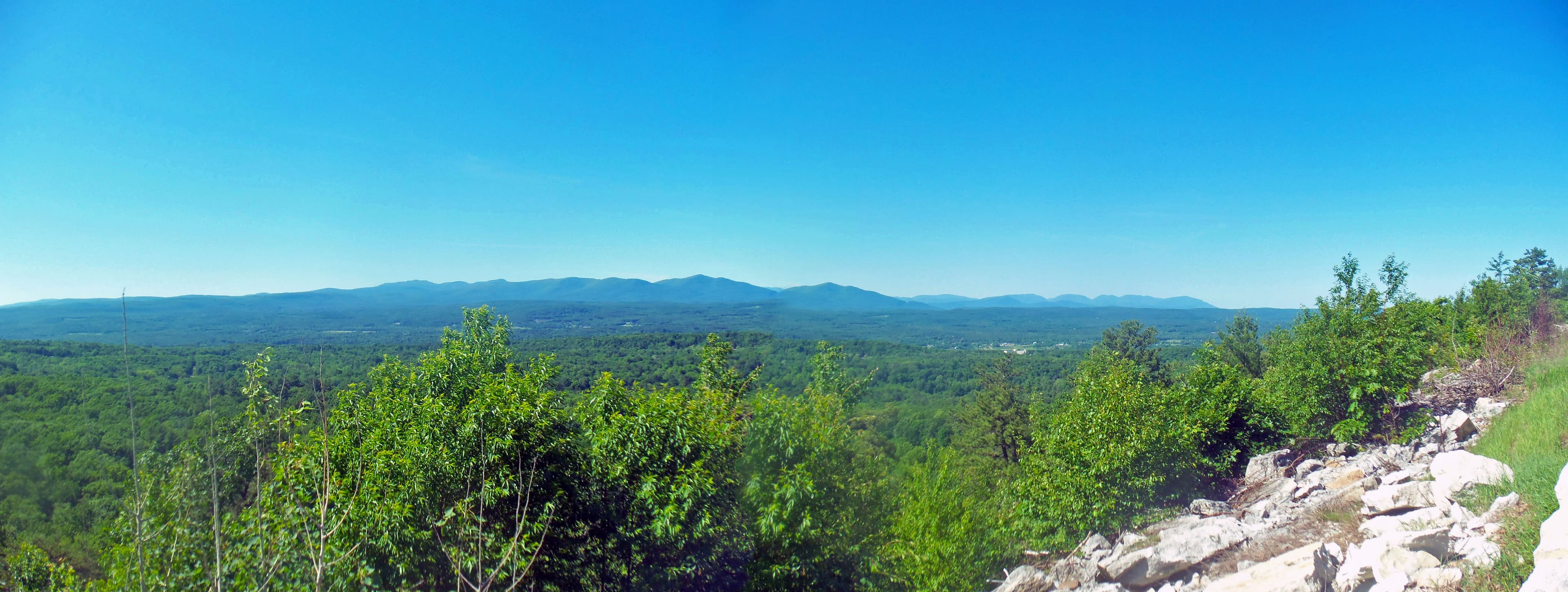
Hero: Catskill Mountains panorama from the Shawangunk Ridge, photograph by Daniel Case, Wikimedia Commons, CC BY-SA 3.0. Displayed without edits. The photograph is a regional view, not a depiction of a prescribed route.
