
Pilgrims’ Way to Canterbury: Start in Winchester or London?
Walk the Pilgrims’ Way from Winchester or London? Compare St Swithun’s Way, Becket Way, route distances, maps and where both approaches meet.

The Pilgrims’ Way to Canterbury has two useful beginnings: Winchester and Southwark in London. They are not interchangeable trailheads. Starting in Winchester brings St Swithun’s Way and the long approach across Hampshire into the walk; starting at Southwark brings a different history and a route out of London through Kent. The approaches join near Otford before continuing toward Canterbury. The British Pilgrimage Trust describes both, but there is no single compulsory historic line that every modern walk follows.
Which start should you choose?
| Begin at | The shape of the walk | Published planning example | On Wyld Quest |
|---|---|---|---|
| Winchester Cathedral | Through Hampshire on St Swithun’s Way toward Farnham, then across Surrey and Kent toward Canterbury. | The British Pilgrimage Trust’s itinerary is 153 miles over 15 walking days. | 16 source-backed place anchors across 15 planning stages. |
| Southwark Cathedral, London | Out of London via Shooters Hill and Dartford, then through Otford to the shared Canterbury approach. | The Trust’s Becket Way itinerary is 90 miles over 11 days. | 11 source-backed place anchors across 10 planning stages. |
These numbers describe particular published itineraries, not universal distances for every possible Pilgrims’ Way. For example, Walking Englishman publishes a 133-mile Winchester route. Different alignments and stage choices explain why two reputable guides can show different totals. And Wyld Quest’s 15 or 10 planning stages are intervals between named places—not measured hiking legs, guaranteed day lengths or GPX navigation tracks.
Choose Winchester if the longer countryside approach and St Swithun’s Way are central to the trip. Choose London if departing from Southwark is the meaningful beginning and you want the shorter of these two broad approaches. Neither requires you to walk every stage in one holiday.
From Winchester: where St Swithun’s Way fits
The Hampshire County Council route runs 34 miles from Winchester to Farnham, beginning at Winchester Cathedral and passing through the Itchen Valley, Alresford and Alton. That first piece is worth treating as a walk in its own right. The council explains that much of the earlier direct alignment now lies beneath the A31, so the modern footpath is not a claim to reproduce every medieval footstep.
Farnham marks an important change of route language. The North Downs Way National Trail starts there and continues east toward Dover, with a Canterbury route choice. The historic Pilgrims’ Way and the National Trail overlap in places but are not precisely the same continuous footpath. A sign for one does not certify every bend of the other. Use the appropriate current map or guide for the line you actually intend to walk.
In the Wyld Quest Winchester itinerary, the ordered reference points run from Winchester Cathedral through New Alresford, Alton and Farnham; farther on they include Guildford, Box Hill, Merstham, Oxted and Otford. These points help you see the progression across counties and return to sections. They are not an instruction to walk straight between map pins.
From London: be specific about which pilgrim route
The Becket Way begins at Southwark Cathedral and uses a Kentward approach via places such as Dartford and the Darent Valley, joining the Winchester tradition around Otford and Kemsing. Wyld Quest’s London to Canterbury option uses Southwark Cathedral, Shooters Hill, Dartford and Otford as its opening planning anchors, then shares the onward sequence to Canterbury.
But “London to Canterbury pilgrimage” is not one uniquely defined route. The British Pilgrimage Trust also describes a distinct Chaucer’s Pilgrims’ Way, a modern footpath interpretation of the Watling Street direction rather than this Becket Way approach. The Confraternity of Pilgrims to Rome publishes a further Francigena Britannica route, connecting Southwark and Canterbury through named existing paths. Its guide and route are separate from a claim that one medieval road can be followed unchanged. Pick one actual guide and its corresponding line; do not join unrelated GPX tracks just because they share a destination.
Where do the Winchester and London walks meet?
At the planning level, Otford is the shared point in Wyld Quest’s two itinerary choices. The British Pilgrimage Trust places the London approach’s join around Otford/Kemsing. From there, Wyld Quest’s recorded sequence includes Wrotham, Halling, Aylesford, Harrietsham, Boughton Lees, Chilham and Canterbury Cathedral.
This is useful when planning with another walker: you can begin separately or walk only the shared latter portion without claiming to have completed either entire route. But a town pin is not a surveyed footpath junction. Consult the current walking guide to locate the actual connection, crossings and access points.
Can you walk it in weekends rather than one trip?
Yes, as a planning approach—provided you choose each day’s actual start, finish and return journey independently. For Winchester, consider St Swithun’s Way as a first discrete project; use Hampshire County Council’s map to divide it by real paths and viable exits. For London, you might start from the Southwark beginning, or begin later along the common Kent approach if a full London departure is not your goal.
Before fixing a day’s endpoints, check the National Rail journey planner for the specific date and stations, and allow for the transfer between a railway station and the actual walking route. A map pin beside a town does not mean an accessible station or an active service at your intended hour. Overnight accommodation, walking pace and transport reliability need their own checks.
On Wyld Quest, select Winchester to Canterbury or London to Canterbury before recording what you walk. The journey keeps the two choices distinct while letting you explore individual places. Do not use the dotted map connections as turn-by-turn navigation; they describe sequence, not verified public rights of way.
What changes when you arrive in Canterbury?
Canterbury Cathedral is the destination of these two pilgrimage approaches and the departure point for a different walk: the Via Francigena toward Rome. On Wyld Quest you can explore the full Canterbury–Rome itinerary or the separate Canterbury–Dover English section. Finishing a walk to Canterbury does not mean that you have walked any part of the continuation.
If entering the cathedral matters to your finish, check its current visiting arrangements instead of assuming you can arrive at any hour. Sightseeing admission and worship are handled differently, and hours or accessible areas can change for services and events. Make space for that arrival when arranging your final day and homeward travel.
The planning checks that matter more than a claimed total mileage
- Choose the actual alignment: Winchester, Becket Way from Southwark, a separate Chaucer route or Francigena Britannica. These names are not interchangeable maps.
- Read the current route guidance: use Hampshire’s St Swithun’s Way map, the National Trail sections and your chosen pilgrimage guide. Recheck path notices and temporary diversions immediately before walking; no blanket current-clearance is implied here.
- Verify logistics yourself: book lodging and confirm rail or other transport on your dates. Do not infer a crossing, overnight bed, open church or right of access from an itinerary stop.
- Track the walk you actually make: open the two Canterbury approaches and record sections without treating unwalked alternatives as completed.
For a first attempt, the route you can explain and navigate is better than an impressive total mileage copied from someone else’s itinerary. Decide where you want to begin, choose a current mapped line, and then divide the walk into days that suit you.
Route sources and photo credit
- British Pilgrimage Trust: Winchester to Canterbury and the two approaches
- British Pilgrimage Trust: Becket Way from Southwark
- British Pilgrimage Trust: separate Chaucer route
- Hampshire County Council: St Swithun’s Way
- North Downs Way: official sections
- Confraternity of Pilgrims to Rome: Francigena Britannica
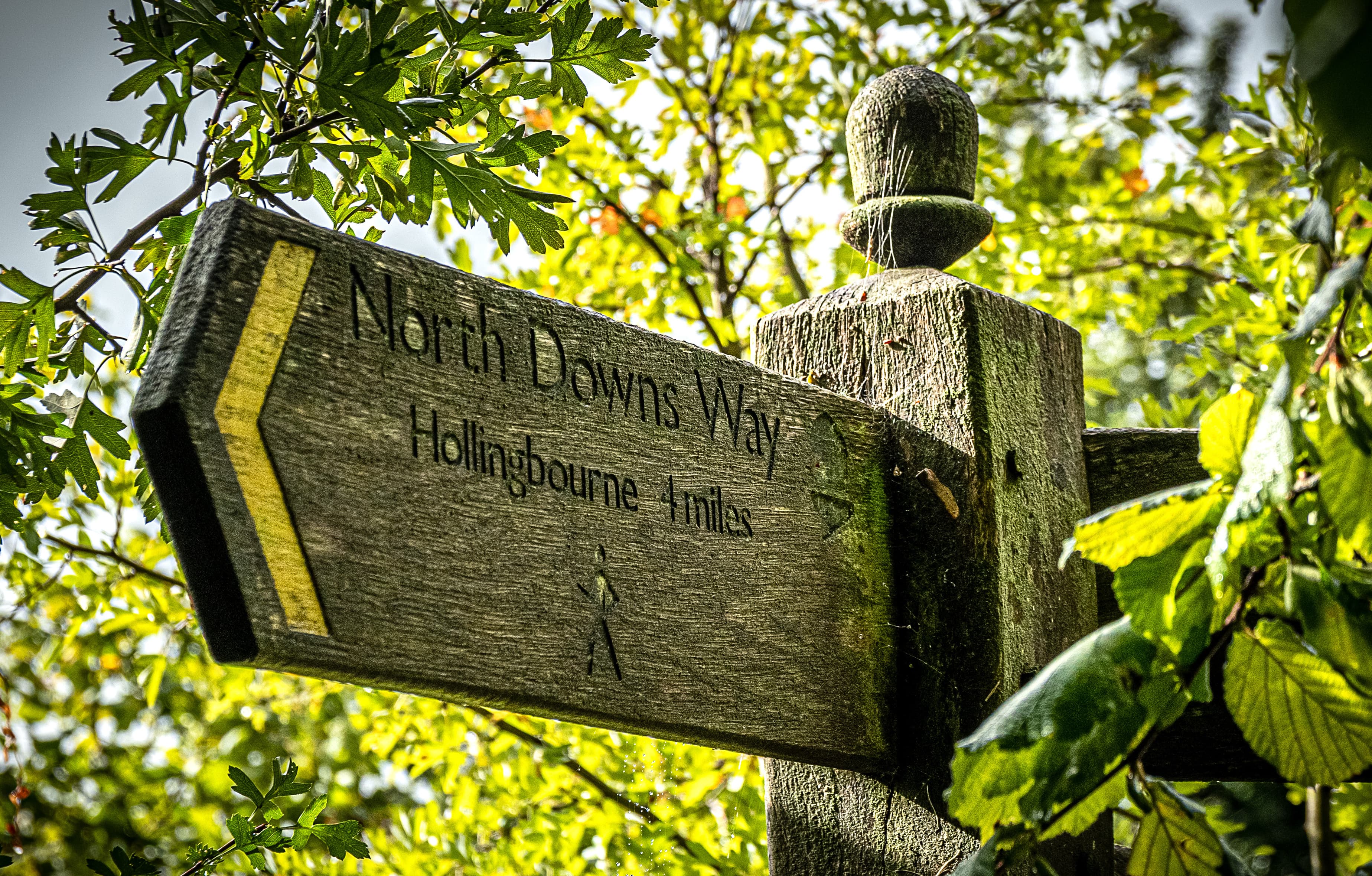
Cover photograph: North Downs Way near Hollingbourne, Kent, photographed 9 September 2022 by Ray B’s world, CC BY 2.0. Wikimedia’s available file was cropped from the photographer’s upload and the display may crop it further. This is a real photograph of that part of the North Downs Way, not either route’s exact starting point or a claim about conditions today.
